
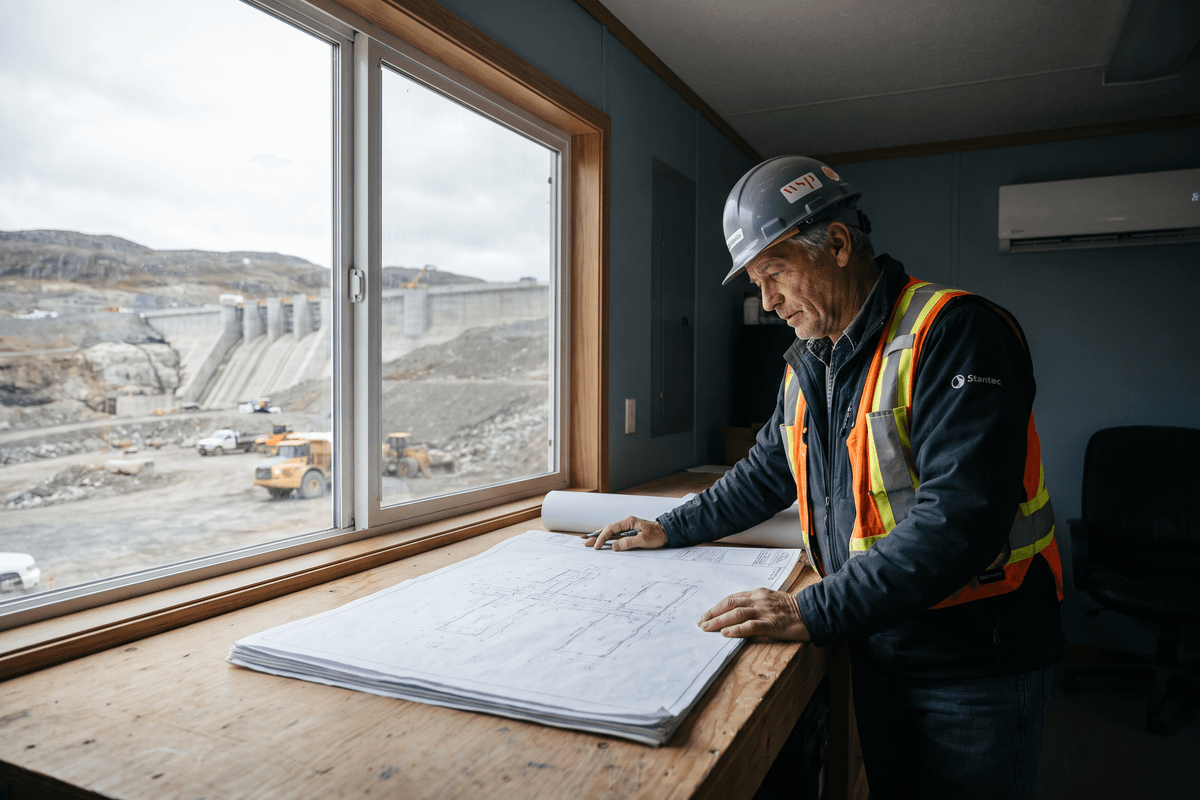

In the rugged Canadian Shield of central Labrador, one of the most ambitious clean energy corridors in North American history is moving from long-debated political ambition into granular, high-precision engineering execution. Comprehensive geotechnical and environmental studies conducted by top-tier Canadian engineering firms Stantec and WSP Global have established the technical groundwork for major clean power initiatives along the Churchill River basin, including the capacity expansion of the iconic 5,428-MW Churchill Falls Generating Station and the prospective development of the long-envisioned 2.7-GW Gull Island hydroelectric facility.
According to reporting on the Churchill Falls hydroelectric expansion advances in Eastern Canada, these baseline investigations provide the empirical rock-mass characterization, hydrological modeling, and environmental impact data essential to derisking multi-billion-dollar clean power capital allocations. For Canada’s engineering community, the Labrador developments represent far more than regional utility upgrades—they signify the return of mega-scale heavy civil and high-voltage electrical engineering to the national grid equation at a time when decarbonization and industrial electrification demand unprecedented baseload power.
The Technical Scale: Brownfield Optimization Meets Greenfield Megaproject
The engineering mandate across the Churchill River corridor encompasses two distinct yet interconnected challenges: maximizing the asset value of an operational 1970s-era mega-facility, and engineering an entirely new world-class hydro generation complex downstream.
The existing Churchill Falls underground powerhouse—carved out of solid granite nearly 300 metres below the Labrador plateau—has operated for more than five decades as one of the largest single underground power-generating facilities in the world. Modernizing and expanding this brownfield asset requires modern computational modeling of existing rock mechanics, turbine runner efficiency upgrades, and the potential addition of new underground caverns and penstocks to capture peak flow capacity without destabilizing historical civil works.
Conversely, the proposed Gull Island project, located approximately 225 kilometres downstream from Churchill Falls, presents a greenfield heavy civil undertaking of extraordinary magnitude. At an anticipated capacity of 2,250 MW to 2,700 MW, Gull Island would feature an earth-and-rockfill dam spanning the river canyon, deep concrete spillways, and a multi-unit powerhouse designed to generate upwards of 12 TWh of firm annual energy. Together, these two projects represent a combined engineering portfolio capable of transforming Eastern Canada’s clean power export capacity.
| Project Component | Project Scope | Primary Engineering Disciplines | Key Technical Complexities |
|---|---|---|---|
| Churchill Falls Expansion | Brownfield underground expansion / turbine retrofits | Geotechnical, Hydro-Mechanical, Structural Cavern Design | Excavation adjacent to live hydro infrastructure; high-pressure hydraulic transient control; rock-burst mitigation in Precambrian granite. |
| Gull Island Development | Greenfield 2.7-GW dam, spillway & underground powerhouse | Heavy Civil, Geotechnical, River Diversion, Hydrology | Mass concrete thermal control; high-flow river diversion tunneling; reservoir slope stability under seasonal freeze-thaw cycles. |
| Intertie & HVDC Transmission | Multi-provincial high-voltage direct current grid lines | High-Voltage Electrical, Transmission, Systems Integration | Sub-zero mechanical ice loading on conductors; converter station harmonic filtering; multi-terminal HVDC grid synchronization. |
Geotechnical Frontiers: Characterizing the Precambrian Shield
The engineering studies carried out by Stantec and WSP Global have focused heavily on sub-surface characterization. In Labrador's Precambrian metamorphic and igneous bedrock, structural geology dictates both feasibility and construction economics. Deep borehole coring, acoustic televiewer logging, cross-hole seismic testing, and in-situ stress measurements are required to assess rock mass quality (Q-system and RMR indexing) at depths exceeding 200 to 400 metres.
"Engineering underground caverns and foundation works of this magnitude in remote sub-Arctic environments requires unprecedented baseline precision. You cannot rely on historical assumptions when integrating new hydraulic circuits alongside active, high-head underground assets."
Geotechnical engineers face several critical design hurdles:
- Stress Regime Mapping: Characterizing high horizontal in-situ stress fields in Precambrian granitic gneiss to prevent stress-induced spalling and cavern wall deformations during excavation.
- Seepage and Grouting Architecture: Designing high-pressure curtain grouting programs to seal fractured bedrock zones beneath extreme hydraulic heads, preventing seepage paths that could destabilize foundation abutments.
- Drilling and Blasting Vibration Limits: For the Churchill Falls expansion, formulating controlled drill-and-blast or mechanical excavation protocols that restrict peak particle velocity (PPV) within stringent thresholds to protect active generating units and transformer vaults.
Hydraulic Optimization and Climate-Resilient Spillway Design
Modern hydroelectric engineering must account for non-stationary hydrological baselines. Decades-old historical flow data no longer suffice for sizing emergency spillways, diversion tunnels, and reservoir retention volumes under accelerating climate volatility.
Advanced computational fluid dynamics (CFD) modeling and 3D hydrodynamic simulations have become central to the current studies. Engineers are modeling extreme Probable Maximum Precipitation (PMP) and Probable Maximum Flood (PMF) scenarios across the vast Churchill River drainage basin (over 70,000 square kilometres). These models inform the design of stepped spillways, aerator slots to combat cavitation at discharge velocities exceeding 30 m/s, and optimized tailrace channel geometry to minimize backwater effects during peak spring freshet events.
Key Environmental and Sedimentation Considerations
- Total Dissolved Gas (TDG) Management: Designing plunge pool dissipation structures to mitigate downstream supersaturation of dissolved nitrogen, which poses risks to native fish species.
- Thermal Stratification and Ice Regimes: Simulating winter anchor-ice and frazil-ice formation in intake bays to prevent blockage and structural fouling under prolonged sub-zero temperatures.
- Methylmercury and Carbon Dynamics: Establishing comprehensive biogeochemical baseline models for soil organic carbon breakdown in newly flooded reservoir zones, guiding pre-inundation biomass clearing strategies.
The Grid Dimension: Engineering the High-Voltage Transmission Backbone
Generating upwards of 10,000 MW of combined clean capacity in Labrador is futile without the structural capability to wheel that power across thousands of kilometres of harsh terrain to major load centres in Quebec, the Atlantic provinces, and the northeastern United States. This reality elevates high-voltage direct current (HVDC) engineering to center stage.
Modern Voltage Source Converter (VSC) technology offers unprecedented grid-forming capabilities, black-start support, and independent active and reactive power control. Integrating new Labrador generation into the wider Northeast power pool requires Canadian electrical engineers to model multi-infeed HVDC interactions, harmonic mitigation, and extreme cold-weather dynamic line rating (DLR) systems capable of withstanding heavy rime ice loading and gale-force wind shear across the Canadian Shield.
Execution Roadmap: Implications for Canadian Engineering Practice
The progression of engineering feasibility and geotechnical investigations by Stantec and WSP Global underscores a critical inflection point for Canada’s consulting and heavy construction sectors. Projects of this scale demand a revival of specialized domestic capabilities in deep tunnelling, hydro-mechanical fabrication, and large-scale project controls.
As these clean power assets move closer to commercial structuring and formal environmental approvals, the demand for licensed professional engineers skilled in rock mechanics, dam safety monitoring, environmental baseline verification, and modern digital twin lifecycle asset management will surge. The Churchill River corridor is once again serving as the supreme test bed for Canadian heavy engineering excellence.
Looking Ahead
The geotechnical and environmental roadmaps now being authored in central Labrador will define clean energy infrastructure standards for the next half-century. By coupling advanced subsurface diagnostics with modern environmental stewardship and cutting-edge electrical grid design, Canadian engineers are laying the foundations for an interconnected, decarbonized continental energy grid that proves heavy engineering and environmental rigor can advance hand-in-hand.