
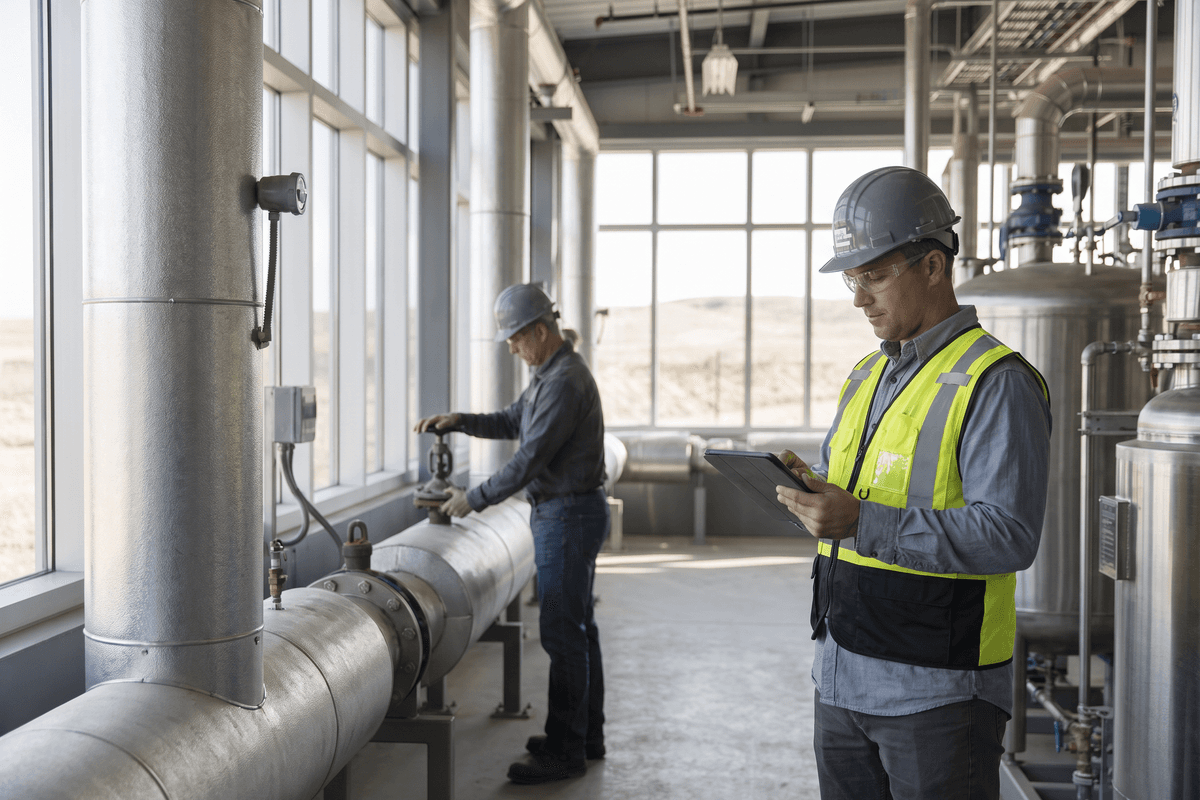



When deep geothermal brine extraction meets advanced chemical process engineering, the conventional boundary between baseload renewable power generation and critical mineral production dissolves. As announced via Energy Global, clean energy technology firm Lithium Harvest has signed a binding Letter of Intent (LOI) to co-develop an integrated geothermal energy generation and Direct Lithium Extraction (DLE) facility in Alberta. By moving the project directly into engineering, design, and technical validation phases, the initiative crystallizes a transformative engineering paradigm: utilizing the thermal enthalpy of deep formation brines to generate clean electricity while simultaneously extracting battery-grade lithium from the exact same fluid stream.
For Canadian engineering professionals, this dual-purpose facility represents far more than an incremental decarbonization play. It represents the maturation of an industrial blueprint that directly repurposes Western Canada’s world-class subsurface expertise, heavy process infrastructure, and regulatory know-how for the critical mineral economy.
The Technical Architecture of Integrated Geothermal-DLE Facilities
The core engineering challenge of Western Canadian Sedimentary Basin (WCSB) brine plays has historically been economic: low lithium concentrations relative to South American salars (typically 50–100 mg/L in Alberta versus 500–1,500 mg/L in the Atacama) coupled with substantial parasitic pumping loads. Integrating geothermal power generation fundamentally rewrites this mass-energy balance.
1. Subsurface Hydrodynamics and Enthalpy Recovery
In target formations such as the Devonian-aged Leduc and Swan Hills carbonate reefs, formation fluids reside at depths between 2,500 and 4,000 metres with temperatures ranging from 90°C to over 140°C. Extracting these brines at commercial flow rates requires high-volume electric submersible pumps (ESPs) deployed in large-diameter production wells.
Reservoir engineers must model not only flow rates and pressure depletion but also thermal drawdown over multi-decade operating horizons. Maintaining fluid enthalpy as brine ascends the wellbore demands precise thermal insulation and tubular metallurgy designed to withstand aggressive, highly saline, and sour (H₂S-bearing) environments.
2. Binary Organic Rankine Cycle (ORC) Power Islands
Because WCSB reservoir temperatures generally fall below high-enthalpy flash steam thresholds, the facility relies on Binary ORC systems. The thermal energy from the pressurized brine is transferred via high-efficiency titanium or duplex stainless steel heat exchangers to a closed-loop working fluid with a low boiling point (such as isopentane or hydrofluoroolefins). The vaporized working fluid expands through a turbine generator to produce baseload electricity before being condensed and recirculated.
"The operational synergy lies in the thermal cascade: the brine is first exploited for its high-temperature enthalpy to drive power generation, and its residual, post-heat-exchanger thermal energy is strategically routed to pre-heat adsorption beds and drive concentration processes in the DLE circuit."
3. The Direct Lithium Extraction (DLE) Process Train
Once cooled to optimal process temperatures (typically 50°C to 70°C), the brine enters the DLE extraction units. Lithium Harvest's engineering validation program focuses on proprietary sorption and selective media technologies designed to strip lithium ions ($Li^+$) from hyper-saline matrices containing dense concentrations of sodium, calcium, magnesium, and chloride ions.
The process sequence involves three core mechanical stages:
- Adsorption/Ion Exchange: Brine flows continuously through columns packed with proprietary media, selectively loading lithium onto active sites while rejecting divalent impurities.
- Elution and Desorption: A dilute acidic or neutral eluent strips the lithium from the media, yielding an enriched, low-impurity lithium chloride ($LiCl$) eluate.
- Polishing and Concentration: The eluate is processed through nanofiltration, reverse osmosis, and thermal evaporation units (powered by waste geothermal heat) to reach concentrations suitable for conversion into lithium carbonate or lithium hydroxide monohydrate.
Comparative Engineering Parameters: Integrated DLE vs. Conventional Extraction
Integrating geothermal generation with DLE radically alters land footprint, chemical consumption, and parasitic energy demand compared to traditional extraction methods:
| Engineering Metric | Evaporative Salar Ponds | Hard Rock (Spodumene) Mining | Integrated Geothermal-DLE (Alberta) |
|---|---|---|---|
| Primary Energy Source | Solar evaporation + grid fossil power | High-carbon fossil fuels / Calcination | Internal Geothermal Baseload (Net-Zero) |
| Processing Cycle Time | 12 to 18 months | Weeks (Milling, pyrometallurgy) | Under 2 hours (Continuous flow) |
| Surface Land Disturbance | 10–50 $km^2$ (Pond systems) | Large-scale open pit / Tailings dams | Compact modular pad (<0.05 $km^2$) |
| Water Footprint | Significant net evaporative water loss | High fresh water consumption / Tailings | Closed-loop (>95% reinjected brine) |
| Lithium Recovery Efficiency | 40% – 50% | 60% – 70% | 85% – 95% |
Thermal-Chemical Optimization and Material Selection Challenges
For Canadian chemical and materials engineers, deep brine processing introduces severe scaling and corrosion risks that require rigorous design validation during the FEED (Front-End Engineering Design) phase.
Scaling Kinetics and Precipitation Control
As deep geothermal brine drops in temperature and pressure across the primary ORC heat exchangers, dynamic chemical equilibrium shifts. Dissolved minerals—particularly silica ($SiO_2$), calcium carbonate ($CaCO_3$), and barium/strontium sulfates ($BaSO_4/SrSO_4$)—reach supersaturation, creating massive scale-deposition risks across heat exchanger tubes and DLE media beds.
Engineers must integrate advanced chemical dosing regimens (anti-scalants and pH modifiers) and design automated backwash and clean-in-place (CIP) loops. Furthermore, keeping the fluid under sufficient backpressure throughout the surface circuit prevents the flash-off of dissolved $CO_2$ and $H_2S$, preserving chemical equilibrium until the brine reaches the reinjection manifold.
Advanced Metallurgy and Elastomer Selection
Brines in the WCSB often exhibit total dissolved solids (TDS) exceeding 200,000 mg/L combined with elevated partial pressures of $H_2S$ and $CO_2$. Standard carbon steels and low-grade stainless steels suffer rapid pitting, stress corrosion cracking (SCC), and sulfide stress cracking (SSC). Process engineers are deploying high-nickel alloys (Inconel 625/C-276), Grade 2/Grade 7 titanium, and Super Duplex stainless steels (2507) for wetted components, while selecting specialized fluoroelastomers (FFKM) for valve seals and pump packings.
Subsurface Integrity and 100% Closed-Loop Reinjection
Unlike open-pit or evaporative extraction operations, the viability of Alberta’s geothermal-DLE facilities hinges entirely on long-term subsurface reservoir management. Every cubic metre of brine extracted must be returned to the target formation under the regulatory oversight of the Alberta Energy Regulator (AER) and the province’s Geothermal Resource Development Act.
Hydrogeological Doublet Design
A standard development leverages a multi-well "doublet" or multi-injector pattern. Production wells withdraw fluid from the structural high of a carbonate reef, while disposal/reinjection wells return depleted brine into structural flanks or contiguous aquifer zones.
Reservoir simulation engineers must optimize well spacing (typically 1.5 to 3.0 kilometres) to achieve two critical objectives:
- Pressure Support: Maintaining continuous hydraulic pressure across the reservoir to sustain production well flow rates over a 25-plus year lifecycle.
- Thermal/Compositional Breakthrough Prevention: Preventing the cooled, lithium-depleted reinjected fluid from migrating prematurely back to the production perforations, which would degrade thermal efficiency and head grade.
Induced Seismicity and Wellbore Integrity
High-volume, continuous reinjection at pressures near formation fracture limits demands continuous real-time microseismic monitoring networks. Engineers must ensure wellbores feature multi-barrier cement integrity across all potable groundwater intervals, validated by ultrasonic cement evaluation logs and continuous annular pressure monitoring.
The Multi-Disciplinary Engineering Transition in Western Canada
The Lithium Harvest project highlights how rapidly Western Canada's traditional oil and gas service sector is pivoting into critical mineral and geothermal execution. The engineering disciplines required to deliver these megaprojects align almost identically with existing Canadian industrial strengths:
- Drilling & Completions Engineers: Transitioning from horizontal hydraulic fracturing to large-bore, high-angle geothermal doublet completions equipped with specialized downhole monitoring instruments.
- Modular Process Skid Designers: Leveraging Alberta's extensive modular fabrication shops in Nisku and Calgary to construct pre-commissioned, transportable DLE extraction and ORC power modules, slashing on-site field construction timelines.
- Supervisory Control & Data Acquisition (SCADA) Specialists: Developing unified digital twin architectures that co-optimize downhole ESP speeds, ORC turbine output, and automated DLE valve manifold cycles based on real-time lithium pricing and electricity market conditions.
Strategic Outlook for Canadian Critical Infrastructure
As Lithium Harvest advances its engineering studies and technical validation milestones, Alberta is proving that the energy transition does not require abandoning subsurface engineering—it requires scaling it into closed-loop, multi-revenue industrial assets. By coupling firm, zero-emission baseload power with the domestic production of battery materials, integrated geothermal-DLE facilities establish a resilient engineering blueprint that secures both critical mineral supply chains and Western Canada’s engineering workforce for decades to come.