
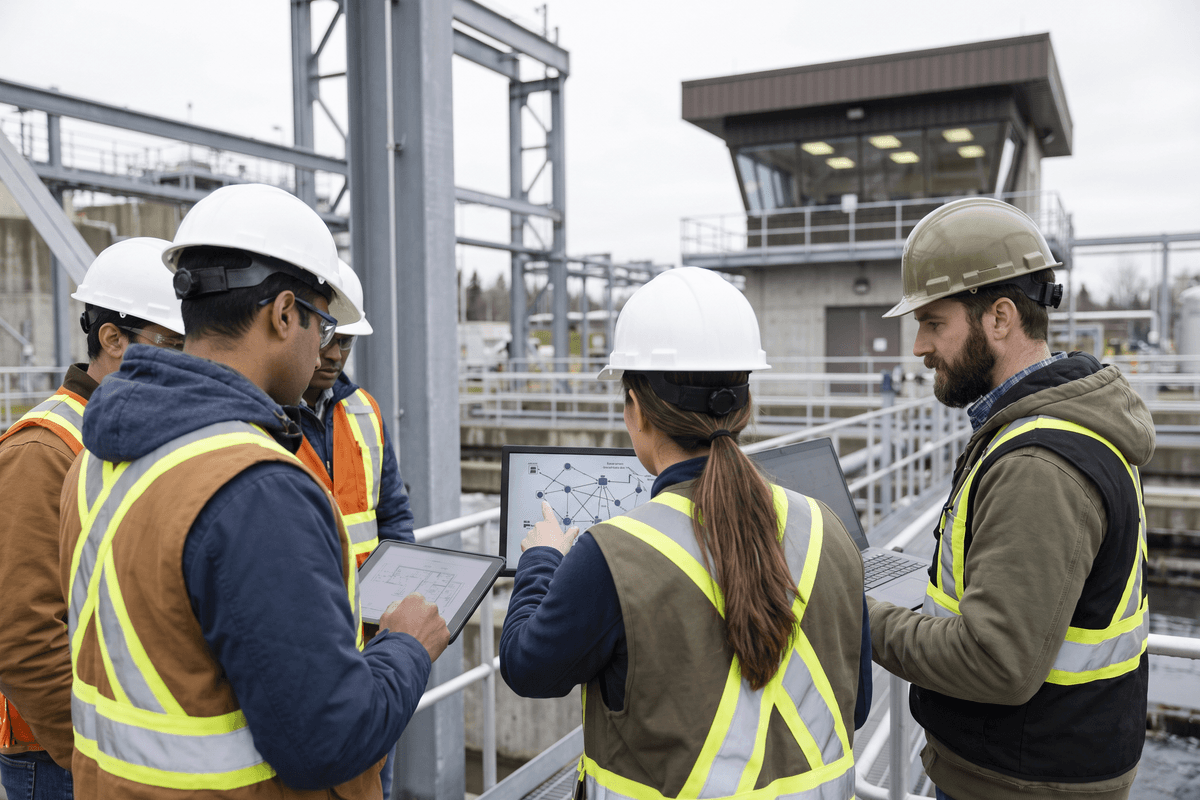

The social contract between Canadian professional engineers and the public is undergoing its most significant expansion in decades. For more than a century, the Iron Ring and the professional engineer’s seal have symbolized an unwavering commitment to physical public safety—ensuring structural loads are calculated accurately, materials resist environmental stress, and physical systems do not fail. However, as Canada’s energy grids, transit networks, and water treatment plants transition into digitized, interconnected cyber-physical assets, the standard of care is rapidly evolving into a dual imperative: protecting operational technology (OT) from sophisticated digital disruption while maintaining uncompromising technical rigor in foundational design.
Two concurrent developments illustrate this shifting landscape. On one front, leading Canadian consulting engineering firm CIMA+ announced a strategic agreement with Tyrex Canada to integrate specialized operational technology and digital cybersecurity directly into transportation, water, and energy infrastructure designs. On the other, a high-profile regulatory action in Atlantic Canada—where a Moncton structural engineer admitted to professional incompetence and surrendered her licence following severe under-design deficiencies in multi-family residential buildings—serves as a stark reminder that advanced digital capabilities cannot substitute for foundational engineering discipline.
The Digital Frontier: Embedding OT Security into Infrastructure Engineering
For decades, municipal and industrial infrastructure segregated physical engineering from digital networks. Supervisory Control and Data Acquisition (SCADA) systems, Programmable Logic Controllers (PLCs), and safety instrumented systems operated in isolated, air-gapped environments. Today, the rise of smart cities, automated wastewater treatment, distributed energy resources (DERs), and intelligent transportation systems (ITS) has permanently dissolved those air gaps.
The strategic alliance between CIMA+ and Tyrex Canada reflects a necessary industry pivot: treating cybersecurity not as a downstream IT consideration, but as an intrinsic engineering discipline embedded in the front-end engineering design (FEED) phase.
"Critical infrastructure can no longer be protected by conventional corporate IT strategies. Operational technology governs kinetic processes—pumps, valves, substations, and signaling systems—where latency, physical safety, and continuous availability are matters of life and death."
When an IT network is compromised, the primary risk is data exfiltration or business disruption. When an OT network controlling a regional water distribution facility or high-voltage substation is compromised, the consequences can include physical asset destruction, environmental contamination, and immediate threats to human life. By partnering with Tyrex Canada, CIMA+ is operationalizing a cyber-physical design methodology that integrates:
- Hardware-Enforced Network Segmentation: Implementing unidirectional security gateways (data diodes) and robust ISA/IEC 62443 compliance frameworks across municipal utilities.
- OT-Specific Vulnerability Assessments: Evaluating industrial control systems without disrupting real-time deterministic operations.
- Resilience by Design: Ensuring automated fallback states that allow physical infrastructure to safely revert to manual or isolated mechanical controls during a cyber intrusion.
The Physical Imperative: Regulatory Accountability and the Baseline of Competence
While the vanguard of Canadian engineering focuses on digital resilience, regulatory bodies across the country are intensifying their scrutiny of foundational technical execution. The disciplinary decision by the Association of Professional Engineers and Geoscientists of New Brunswick (APEGNB) involving a Moncton structural engineer underscores the severe consequences when basic design principles and quality assurance fail.
In that case, the professional admitted to incompetence after provincial reviews revealed severe structural under-design in multiple multi-unit residential projects—necessitating costly emergency remediation, structural shoring, and the eventual surrender of her professional licence alongside substantial disciplinary fines. The case reverberated across Atlantic Canada’s development sector, illustrating how rapidly institutional trust deteriorates when internal quality controls break down.
This regulatory action serves as a vital case study for engineering firm leadership. In an era marked by aggressive construction schedules, labor shortages, and rapid urbanization, the pressure to accelerate deliverable sign-offs creates unacceptable risk vectors if not counterbalanced by rigorous oversight.
Key Structural Vulnerabilities Highlighted in Regulatory Inquiries
- Inadequate Load Path Continuity: Overlooking critical shear walls, lateral load transfer mechanisms, and progressive collapse prevention in multi-storey wood and hybrid structures.
- Insufficient Foundation Interface Modeling: Failing to accurately reconcile dynamic soil-structure interactions with differential settlement calculations.
- Deficient Construction Phase Oversight: Omitting detailed field reviews to verify that constructed assemblies precisely match sealed engineering drawings.
The Intersecting Threat Matrix: Physical vs. Operational Technology Risks
Modern engineering projects operate within a continuous risk matrix where physical mechanics and digital control systems intersect. Canadian consulting firms must manage vulnerabilities across both dimensions simultaneously.
| Infrastructure Domain | Physical & Structural Risk Vectors | Operational Technology (OT) Cyber Risk Vectors | Engineering Mitigation Strategy |
|---|---|---|---|
| Water & Wastewater Treatment | Hydraulic surge, tank shear failure, seismic joint rupture, chemical corrosion. | Unauthorized PLC tampering, false sensor telemetry, chemical dosing manipulation. | Mechanical pressure relief valves paired with ISA/IEC 62443-segmented SCADA architectures. |
| Energy & Power Substations | Transformer foundation settlement, thermal overload, busbar dynamic stress. | Coordinated breaker tripping via compromised relays, IEC 61850 protocol poisoning. | Physical blast walls, isolated protection relays, and out-of-band analog monitoring. |
| Intelligent Transportation (ITS) | Bridge deck fatigue, overhead gantry wind-load vibrations, pavement deflection. | Traffic controller hijacking, variable message sign spoofing, fleet telematics injection. | Structural fatigue-resistant detailing alongside zero-trust network access (ZTNA) for field cabinets. |
| Multi-Residential & Commercial | Load path discontinuity, undersized transfer slabs, thermal bridging collapse. | Smart Building Management System (BMS) intrusion, unauthorized fire suppression overrides. | Mandatory third-party structural peer review and physically segregated life-safety networks. |
Actionable Strategies for Canadian Engineering Firms
To navigate this complex regulatory and operational landscape, engineering executives, project managers, and lead designers must implement institutional safeguards that simultaneously elevate digital security and protect physical integrity.
1. Formalize Independent Technical Reviews (ITRs)
Firms must establish non-negotiable peer-review gates within their Quality Management Systems (QMS). Before any drawing set receives a professional engineer's stamp, an independent senior engineer—uninvolved in the project’s day-to-day delivery—must audit design calculations, load assumptions, and code compliance frameworks. As demonstrated by recent disciplinary actions, relying solely on self-checks under tight deadlines is a direct route to professional liability claims.
2. Integrate OT Cybersecurity into the Standard FEED Workflow
Rather than treating industrial cybersecurity as an aftermarket add-on provided by external IT vendors, firms should follow the CIMA+ model by embedding OT security specialists directly into project teams. Cyber threat modeling, protocol isolation, and fail-safe mechanical fallbacks must be established during preliminary design reports (PDR) and carried through to final commissioning.
3. Close the Continuing Professional Development (CPD) Gap
Provincial regulators (including PEO, OIQ, EGBC, and APEGA) are increasingly mandating continuous competency tracking. Engineering practices must establish internal training programs focusing on both emerging digital systems and evolving structural building codes (such as the latest updates to the National Building Code of Canada and CSA standards for timber, steel, and concrete design).
The Road Ahead: Safeguarding Trust in Canadian Engineering
Canadian engineering stands at an inflection point. The transition toward intelligent, decentralized, and decarbonized infrastructure brings immense technical opportunity, but it also multiplies the surfaces of vulnerability. A modern bridge, treatment facility, or residential complex is no longer just concrete and steel; it is an integrated ecosystem of mechanical materials and digital control networks.
Whether navigating the cyber-physical frontier alongside partners like Tyrex Canada or reaffirming the uncompromising baseline of structural calculations in municipal housing, the duty of the Canadian engineer remains unchanged: safeguarding public welfare through demonstrable competence, ethical rigour, and forward-thinking design.