
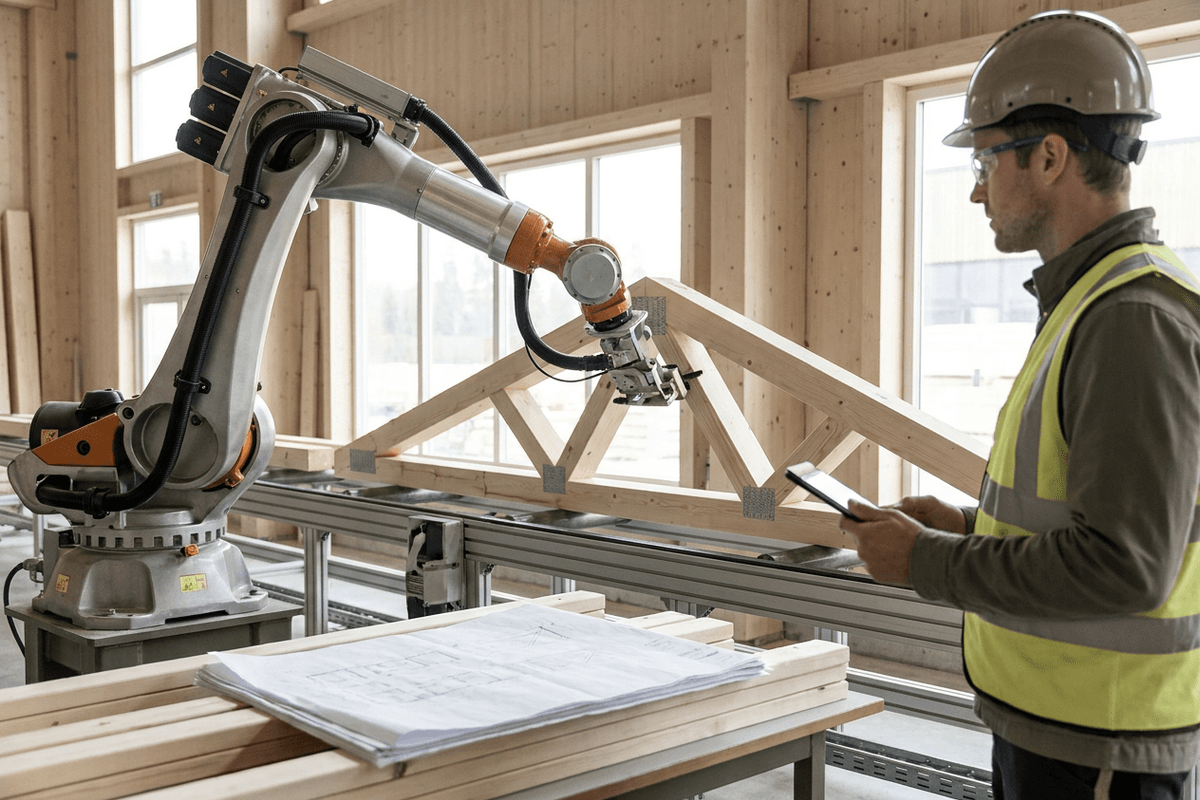

The traditional construction jobsite—long vulnerable to Canadian winter weather disruptions, acute skilled labour shortages, and compounding dimensional variance—is undergoing a permanent structural realignment. As announced in recent industry developments detailing how new building-component plants advance off-site construction in Canada and the US, Canada has officially brought its first fully robotic roof-truss manufacturing line into commercial operation in Ontario. This milestone is far more than an incremental factory upgrade; it marks the decisive convergence of advanced industrial robotics, computational structural design, and automated timber prefabrication in the domestic construction sector.
The Mechanics of Robotic Roof-Truss Fabrication
Traditional wood truss manufacturing, while partially industrialized for decades through manual jigging, pneumatic clamping, and human-placed connector plates, has consistently faced quality-control bottlenecks and ergonomic constraints. In contrast, the modern robotic truss manufacturing line integrates multi-axis industrial articulated robots, automated timber handling systems, computerized optical scanning, and algorithmic plate placement.
Under this automated workflow, engineering models generated in structural framing software feed direct machine-control code to robotic end-effectors. The operational sequence delivers transformative precision:
- Automated Infeed and High-Speed Precision Cutting: Lumber is digitally measured, scanned for moisture and defect characteristics, and precision-cut using multi-angle automated saws that maximize yield and eliminate cutting errors.
- Robotic Member Placement and Jig Setting: Articulated robots position top chords, bottom chords, webs, and internal bracing into dynamic, automated jigging beds that self-adjust based on coordinate geometry exported directly from structural calculations.
- Precision Plate Positioning and Continuous Hydraulic Pressing: Metal connector plates (toothed truss plates) are picked and placed by high-speed magnetic or vacuum grippers with sub-millimetre repeatability, followed by single-pass roller or hydraulic pressing that ensures uniform plate embedment without wood-fibre crush damage.
- Digital QA/QC and Real-Time Telemetry: Every finished truss undergoes automated optical dimension checks and barcode tagging for direct tracking to site logistics systems.
"Automated roof-truss fabrication bridges the historic divide between structural engineering design software and physical jobsite execution, turning engineered timber models into zero-tolerance physical components in minutes."
Industrialized Construction: Comparing Delivery Methodologies
For Canadian structural and civil engineers evaluating off-site prefabricated systems against conventional site practices, the technical parameters underscore significant gains in structural consistency, schedule reliability, and safety.
| Performance Metric | Stick-Built Jobsite Framing | Conventional Component Plant | Robotic Component Manufacturing |
|---|---|---|---|
| Dimensional Tolerances | ±6 mm to ±15 mm | ±3 mm to ±5 mm | ±0.5 mm to ±1.5 mm |
| Connector Plate Placement Variance | Manual field alignment / high variance | Operator-dependent (±5 mm) | Automated optical alignment (±0.5 mm) |
| Material Waste Generation | 12% – 18% on-site | 5% – 8% off-site | < 2% optimized digital nesting |
| Throughput / Cycle Time | Days to weeks per roof structure | Hours per truss assembly | Minutes per complex truss profile |
| Weather Vulnerability | High (snow, rain, freeze-thaw) | Low (assembled indoors) | Negligible (fully climate-controlled) |
Engineering Practice Impacts: DfMA and CSA Standard Compliance
The acceleration of robotic off-site manufacturing fundamentally alters the daily practice of Canadian structural engineers. Designing for automated production requires a shift toward Design for Manufacture and Assembly (DfMA), where structural details must conform not only to building code gravity and lateral loads, but also to automated handling kinematics and transportation constraints.
1. Seamless Digital Thread (BIM to CAM)
In standard structural workflows, design drawings undergo translation by truss manufacturers into proprietary manufacturing files, often creating friction and revision cycles. With robotic assembly, Canadian engineering teams must work within connected digital frameworks where structural design packages (such as Revit, Dietrich's, Cadwork, or MiTek) interface directly via IFC and CNC open data formats (such as BTL or BTLx) without manual redrafting.
2. Compliance with CSA O86 and CSA A277
Precision manufacturing aligns closely with national standards governing wood design and factory-built construction. Automated pressing ensures that tooth-holding values and tension/shear capacities mandated by CSA O86 (Engineering Design in Wood) are reliably achieved across every joint. Furthermore, plants operating under CSA A277 (Procedure for Certification of Prefabricated Buildings) benefit from automated quality assurance logging, generating audit trails for structural sign-offs and municipal building inspectors.
3. Embodied Carbon and Mass Timber Synergies
As Canadian provinces introduce stricter embodied carbon reporting and Tier 3/4 building performance tiers under the National Building Code, robotic timber optimization plays an essential role. Precise algorithmic nesting reduces wood scrap, optimizes localized lumber grades (placing higher Machine Stress Rated [MSR] lumber strictly where tension stresses demand it), and complements hybrid mass timber and light-frame residential structures.
Overcoming Supply Chain and Skilled Labour Bottlenecks
The Canadian construction sector faces unprecedented demand for multi-family residential units, social housing, and institutional facilities amid an aging trade workforce. According to BuildForce Canada projections, tens of thousands of skilled carpenters and framers will retire over the coming decade. Robotic component lines do not replace human engineers and trades; rather, they upskill factory personnel into robotic operators, CNC programmers, and quality-assurance technicians while transferring hazardous overhead framing tasks into controlled ground-level environments.
Furthermore, because robotic manufacturing plants can operate on multi-shift schedules regardless of external climate conditions, Canadian prefabricators can maintain consistent year-round production. This enables just-in-time delivery to urban and remote construction sites, cutting field installation timelines from weeks to days and mitigating crane rental overheads.
The Strategic Path Forward for Canadian Engineering
The commissioning of Ontario's first robotic roof-truss line represents an initial benchmark in a broader industrial transformation. As component manufacturing scales across Ontario, Quebec, Alberta, and British Columbia, consulting engineers who master parametric component modeling, automated prefabrication tolerances, and integrated factory logistics will capture a decisive competitive advantage.
Industrialized construction is moving from niche modular prototypes to mainstream structural infrastructure. By embracing robotic prefabrication and precision manufacturing principles, Canadian engineering is building a more resilient, productive, and technologically advanced national built environment.