Learn how isotope ratios and nutrient concentration trends reveal the sources and fate of nutrients in irrigation canals, and how those findings support nutrient management.
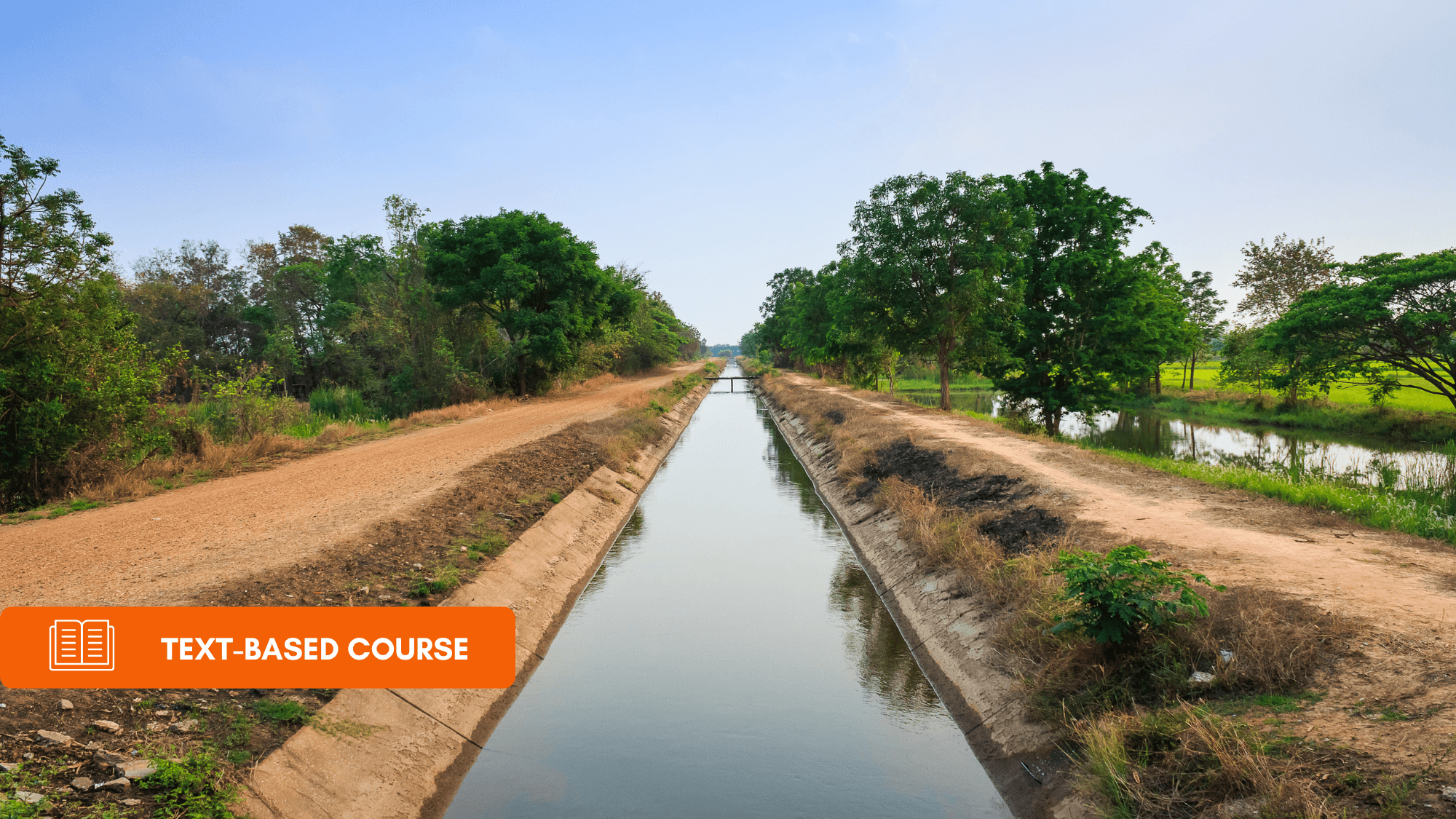
Nuisance aquatic vegetation in irrigation canals reduces conveyance capacity and threatens reliable water delivery, and controlling it starts with knowing where the nutrients come from. This course interprets field results from twelve canal segments across four southern Alberta irrigation districts. Learners examine longitudinal and temporal trends in carbon and nitrate isotope ratios and in concentrations of total inorganic carbon, nitrate, nitrite, ammonia, total nitrogen and phosphorus. The course then explains how dissolved inorganic carbon (DIC) isotope values point to soil organic matter and carbonate rock dissolution as dominant carbon sources, and how seasonal photosynthesis and respiration shift those signatures.
The course focuses on nitrogen source attribution using dual nitrate isotope plots, comparing canal water with manure, fertilized, manured, nitrogen-fixing and grassland soils, drainage water and municipal effluent. Learners explore nitrogen transformation processes including mineralization, nitrification, assimilation and denitrification, and how mixing of multiple sources is recognized. Comparisons by canal type and by earthen versus lined bed material, and between canal water and periphyton, macrophytes and sediment, are also covered. The course closes with practical nutrient management measures, such as agronomic manure application rates and limiting nutrient-laden drainage into canals, that engineers in Canada can use to reduce nutrient loading and vegetation growth.
What Will Be Covered:
Longitudinal and temporal trends in canal water isotope ratios and nutrient concentrations
Behaviour of carbon, nitrogen and phosphorus concentrations along canal segments
Sources of dissolved inorganic carbon and seasonal effects of photosynthesis and respiration
Dual nitrate isotope plots for attributing nitrate to soil, manure and fertilizer sources
Nitrogen transformation processes: mineralization, nitrification, assimilation and denitrification
Influence of land use and livestock density on nitrate sources by district
Comparison of primary, secondary and return canals and earthen versus lined canals
Isotopic links between canal water and periphyton, macrophytes and sediment
Nutrient management practices to reduce nutrient loading and aquatic vegetation growth

Leading Global Provider of Cutting-Edge Engineering CPD Courses
The Global Engineering Excellence Institute (GEEI) is a leading provider of Continuing Professional Development (CPD) courses designed to meet the evolving needs of engineers worldwide. Established in 2010, GEEI has a proven track record of delivering high-quality, industry-relevant training that empowers engineering professionals to stay at the forefront of technological advancements and best practices. Our comprehensive course offerings cover a wide range of disciplines, including civil, mechanical, electrical, and software engineering, ensuring that our learners receive the most up-to-date and practical knowledge. With a focus on practical application, GEEI's courses are developed by industry experts and are recognized by leading engineering bodies globally. We are committed to fostering a culture of continuous learning and professional growth, helping engineers achieve their career goals and contribute to the advancement of the engineering profession.
