
search
Design criteria, post-tensioning layout, load history and load effects for a four-span NU girder river crossing with two-stage post-tensioning.
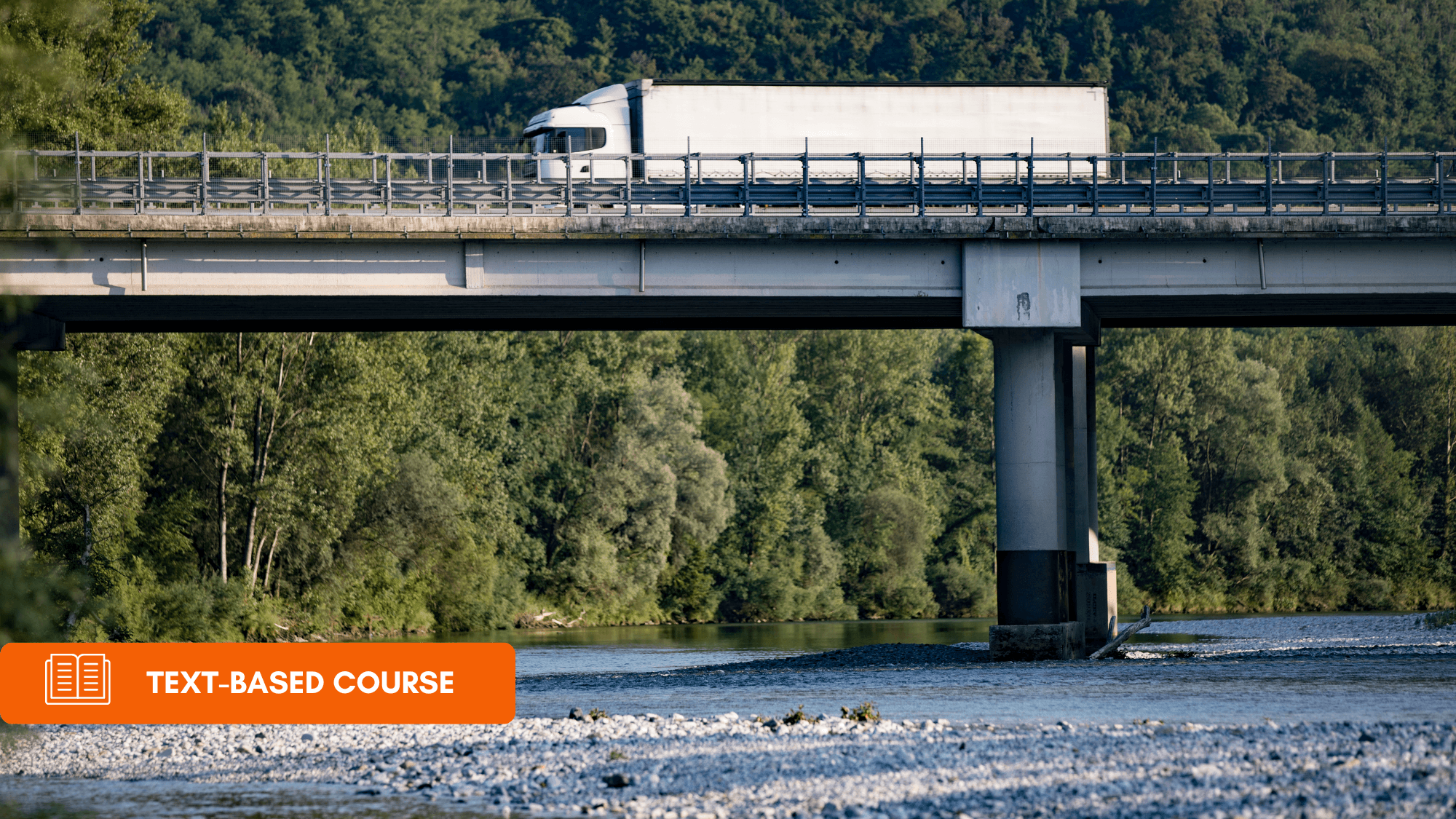
This course develops the design basis for a four-span river crossing about 199 m long, with unbalanced spans of 32.5 m to 65 m, built with NU2800 precast girders that are both pretensioned and post-tensioned in two stages to become fully continuous. Learners examine the bridge geometry, material properties and time-dependent concrete behaviour, developing shrinkage and creep functions for girder and deck concrete for use in the Age Adjusted Effective Modulus (AAEM) method, the detailed approach required by the Canadian Highway Bridge Design Code (CSA S6) for bridges with complex load histories. Section properties, the pretensioned strand layout with deviated and debonded strands, and the optimization of a parabolic tendon profile are developed step by step.
Learners then calculate post-tensioning friction, wobble and anchorage seating losses for jacking from both ends, and define the full load history from fabrication through diaphragm construction, the deck pour, second-stage stressing and superimposed dead loads. Each load case is quantified: girder self-weight, deck weight, superimposed dead loads, temporary construction loading, vehicle live load with simplified lateral distribution, primary and secondary post-tensioning effects, differential shrinkage, creep restraint and summer and winter temperature differentials. The flexibility method is used for the continuous structure. Learners finish with organized load summaries ready for the serviceability and ultimate limit state checks of a multi-span NU girder bridge.
What Will Be Covered:
Bridge geometry, span arrangement and articulation of a four-span river crossing
Material properties and time-dependent shrinkage and creep functions for girder and deck concrete
Creep coefficients and adjusted age at loading for use in the AAEM method
NU2800 section properties and a pretensioned layout with deviated and debonded strands
Optimization of a parabolic post-tensioning tendon profile and duct clearances
Friction, wobble and anchorage seating losses with jacking from both ends
Load history and staging, including two-stage post-tensioning
Dead, construction and live load cases with simplified live load distribution
Primary and secondary post-tensioning effects by the flexibility method
Differential shrinkage, creep restraint and temperature differential load effects

Leading Global Provider of Cutting-Edge Engineering CPD Courses
The Global Engineering Excellence Institute (GEEI) is a leading provider of Continuing Professional Development (CPD) courses designed to meet the evolving needs of engineers worldwide. Established in 2010, GEEI has a proven track record of delivering high-quality, industry-relevant training that empowers engineering professionals to stay at the forefront of technological advancements and best practices. Our comprehensive course offerings cover a wide range of disciplines, including civil, mechanical, electrical, and software engineering, ensuring that our learners receive the most up-to-date and practical knowledge. With a focus on practical application, GEEI's courses are developed by industry experts and are recognized by leading engineering bodies globally. We are committed to fostering a culture of continuous learning and professional growth, helping engineers achieve their career goals and contribute to the advancement of the engineering profession.