This course describes turbo roundabouts, highlighting the design and traffic control features, operational capabilities, and potential safety benefits.
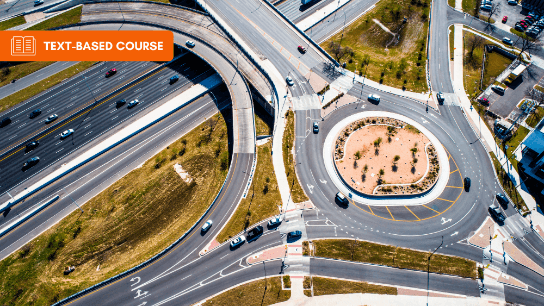
In this online engineering PDH course, an alternative form of multi-lane roundabout, called a “turbo roundabout,” is described. Though most roundabouts in the United States are single-lane roundabouts, multi-lane roundabouts are becoming increasingly common. Some of these multi-lane roundabouts have experienced higher than expected frequencies of sideswipe—same direction crashes. In the Netherlands in the 1990s, the turbo roundabout was introduced with the goal of influencing driver behavior and reducing lane change conflicts in a way that would address the crash types occurring in multi-lane roundabouts. In recent years, the Netherlands, Germany, Poland, and Canada have implemented turbo roundabouts with positive effects on safety. The turbo roundabout has the same general operating characteristics as modern roundabouts but utilizes notably different geometrics and applications of traffic control devices. This course describes turbo roundabouts, highlighting the design and traffic control features, operational capabilities, and potential safety benefits.
Topics: Characteristics of a turbo roundabout Potential benefits of turbo roundabouts User considerations Location considerations Safety analysis methods and results Operational analysis Design considerations Costs.
Intended Audience: This course is intended for civil and transportation engineers concerned with the design and construction of intersections.
Publication Source: This course is based on the U.S. Department of Transportation FHWA Safety Program document, FHWA-SA-20-019, titled “Turbo Roundabouts”.
2 activities • 1 chapters • duration: 2 hours
Civil Engneering faculty member for 27 years
Dr. Rossow is a graduate of the University of Michigan with B.S., M.S., and Ph.D. degrees. He is a licensed Professional Engineer in the State of Illinois. He taught civil engineering for over 35 years, including six years at Washington University in St. Louis and 29 years at Southern Illinois University Edwardsville, where he was the Chair of the Civil Engineering Department for ten years. His areas of expertise are in civil engineering and mechanics. He has consulted for various organizations, including government agencies and an international offshore drilling company. He has published numerous technical journal articles and technical reports for a variety of governmental agencies and private sector organizations. Mark P. Rossow, PE, PhD Licensed Professional Engineer in State of Illinois License No. 062.040560 Dr. Rossow is a graduate of the University of Michigan with B.S., M.S., and Ph.D. degrees. He taught civil engineering for over 35 years, including six years at Washington University in St. Louis and 29 years at Southern Illinois University Edwardsville, where he was the Chair of the Civil Engineering Department for ten years. His areas of expertise are in civil engineering and mechanics. He has consulted for various organizations, including government agencies and an international offshore drilling company. He has published many journal articles and technical reports.
Yes, this course was an excellent match for me. As a roadway/highway designer, it is good to learn about other roundabout options and how they operate, especially since roundabouts are becoming the "go to " alternative for signalized and stop-controlled intersections in municipalities across Canada.
The material offered nice comparison between turbo and multilane roundabouts that can be quite useful. ( I did notice some a my quiz answers were marked incorrect, even though I was able to confirm them to be correct in the text.)
