
search
Establish eligibility, select the correct baseline and define the project boundary for biogas production and combustion projects seeking emission offsets in Alberta.
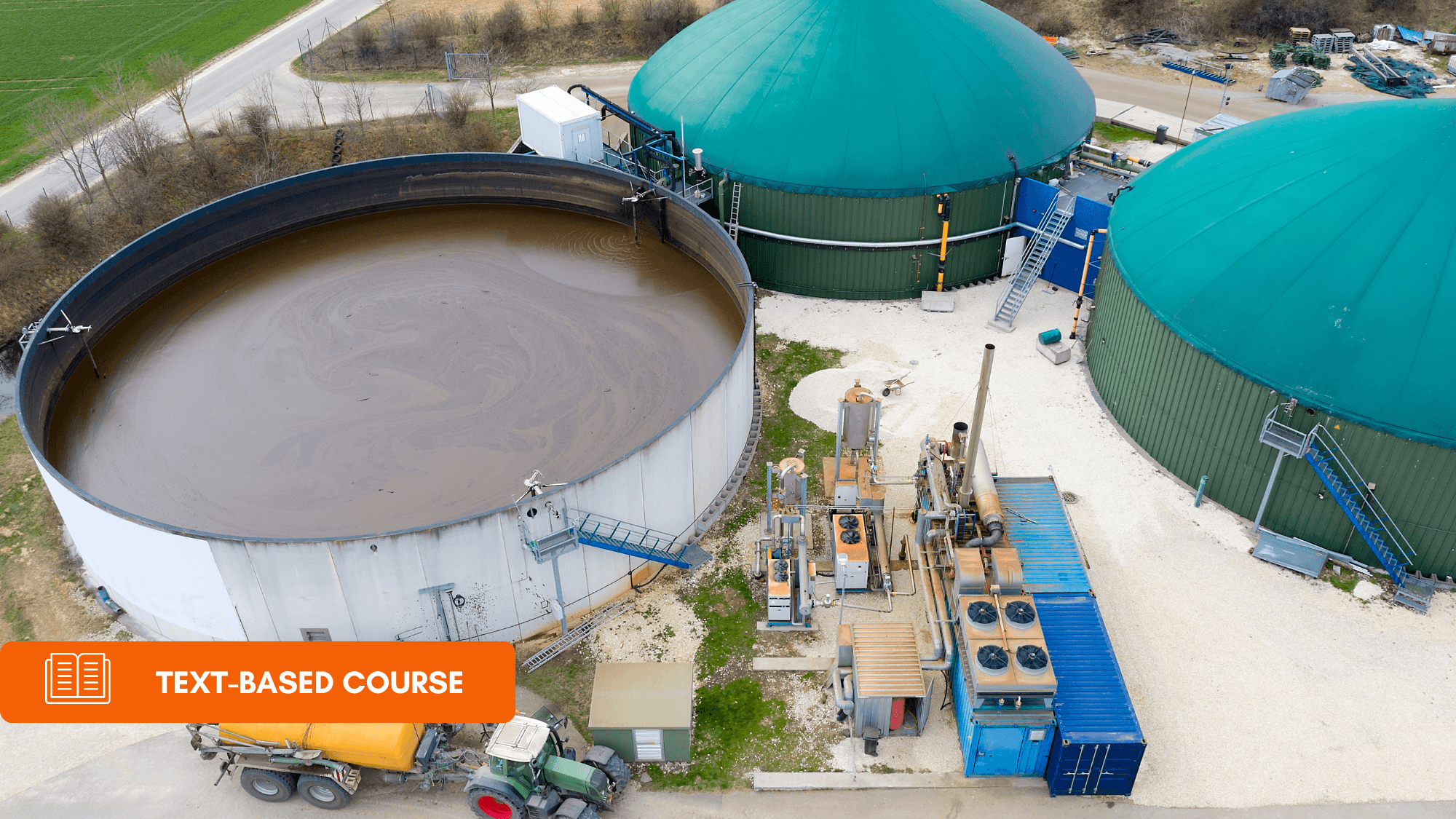
Anaerobic digestion of wastewater, manure and organic solid waste can capture methane that would otherwise reach the atmosphere and turn it into useful heat, electricity or pipeline gas. Turning that outcome into creditable emission offsets under the provincial offset system depends on getting the fundamentals right before any numbers are calculated. This course explains which feedstocks and activities qualify, why only waste products may be used, why flaring and avoided methane from municipal wastewater cannot generate offsets, and how priced emission sources must still be tracked and reported even though they are not eligible for credit.
The course then works through the eligible baseline conditions for brownfield and greenfield solid waste digestion, liquid manure storage and wastewater treatment, including the tests for passive anaerobic treatment such as the minimum one metre depth. It explains how baseline and project sources and sinks (SS) are classified as controlled, related or affected, arranged upstream, on site and downstream, and then included in or excluded from quantification on the grounds of materiality, functional equivalence and conservativeness. It suits engineers and technologists who design, operate or assess anaerobic digesters, biogas systems and wastewater facilities and need to scope an offset project defensibly.
What Will Be Covered:
Emission offset opportunities from wastewater, liquid manure and diverted solid organic waste
Applicability conditions, including waste-only feedstocks, disposal records, digestate handling and land spreading requirements
Fugitive emissions management with leak detection and repair at commissioning and annually
Flexibility mechanisms: heat transfer modelling of baseline wastewater temperature, site-specific emission factors and the 24-hour temporary storage exclusion
Key terms such as chemical oxygen demand (COD), methane conversion factor (MCF) and functional equivalence
Dynamic, project-specific baselines recalculated for each reporting period
Eligible baseline conditions for brownfield and greenfield solid waste, liquid manure and wastewater projects
Classification of greenhouse gas (GHG) sources and sinks as controlled, related or affected and by timing relative to the project
Project condition sources such as biogas flaring, venting, combustion, biogenic carbon dioxide and electricity use
Justifications for including or excluding each source and sink from quantification

Professional online education for engineers and technical professionals
Engineering Education Group provides online professional development and continuing education courses for engineers, technical professionals, and industry practitioners. Our programs focus on practical skills, technical knowledge, industry standards, and lifelong learning through flexible and accessible online education.